

By Laurie Goering
PARIS, Jan 16 (Thomson Reuters Foundation) – Wildfires around the world are surging in number, size, strength and destruction, driven partly by global warming, while ever more people and their homes lie in the path of danger, researchers warned on Thursday.
But cutting fire losses and risks is proving a gargantuan task, not least because communities – whether in Australia or California – like living near forests and have so far been little deterred by the growing threat, fire experts said.
That is presenting a host of challenges, from insurers suffering increasingly crippling losses, to firefighting managers who have to decide where to deploy limited resources.
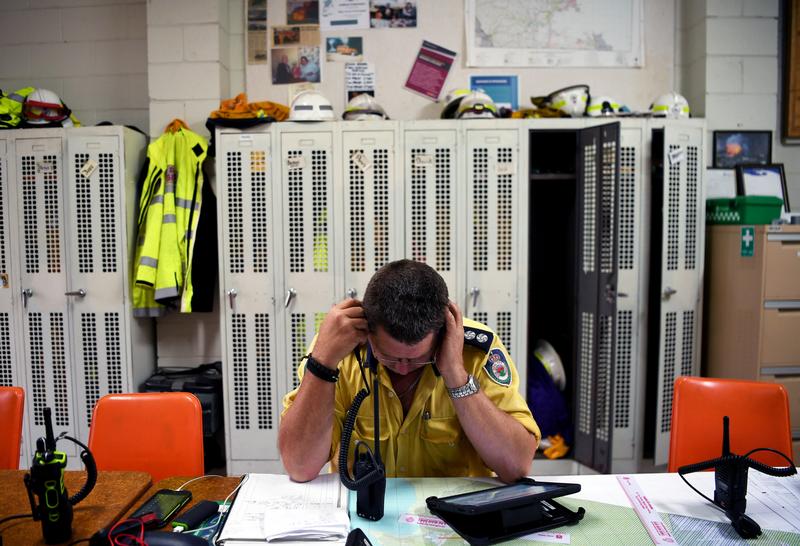
Nowhere has the problem been more evident than in Australia, where wildfires – many out of control in the hottest and driest year on record – have burned through every state in two months.
The blazes have now consumed 17 million hectares (42 million acres), about 2,800 homes and 28 lives, said Alexander Robson, Australia’s representative to the Organisation for Economic Co-operation and Development in Paris, where the fire experts met to share ideas.
With 85 fires still burning, 30 of them not yet contained, the damage is expected to rise, Robson said, calling the fires “unprecedented”.
The Australian crisis, however, is just the most recent of fire upswings from California to Portugal and Canada, all of which are seeking to revamp their fire management policies to try to meet the challenge.
“If this is the ‘new normal’, then tweaking well-established approaches to risk management of wildfires will not make any difference,” warned John Handmer, a science advisor on risk for the International Institute for Applied Systems Analysis.
But tweaks are “almost entirely what’s being discussed in Australia at the moment”, said Handmer, who lives in the capital Canberra, which has been choked with wildfire smoke this month.
BEAUTIFUL BUT DEADLY
Australia and other fire-hit nations need “a new approach”, he said, such as rethinking evacuation practices and tightening building codes and urban planning rules.
Creating fire risk maps could make homeowners more aware of threats or limit expansion into wooded areas by enabling insurance costs to better reflect real risks.
But the essential problem, researchers said, is rising populations in places like Australia and the United States, coupled with a desire to live in pleasant environments, putting many more people in the path of fires.
Between 1990 and 2010, the number of housing units next to or within forested areas grew by 60% in the United States, according to research by Volker Radeloff, a forest and wildlife ecology professor at the University of Wisconsin-Madison.
That means when fires start, many more homes can burn. But while fire losses can deter new building in an area for a year or two, the effect doesn’t last long, researchers said.
“People know they live in a risky place. It’s not stupidity,” Radeloff said. The truth is, “they are beautiful places to live. I would love to live in these homes.”
A culture promoting quick rebuilding after wildfires, both because communities rely on property taxes and because homeowners want it, also can be problematic.
“The political response to a large event is always, ‘We will rebuild.’ It’s almost a knee-jerk response,” said Richard Thornton, chief executive officer of the Bushfire and Natural Hazards Cooperative Research Centre in Australia.
But in the longer term, it may be more sensible not to rebuild in the same way or in exactly the same places, said Thornton, whose own home backs onto a forested area.