

• Bolsonaro government set out to rein in Funai agency
• Missing expert Bruno Pereira among many sidelined staff
• Land grabbers seen stronger as Funai ‘reverses’ mission
By Andre Cabette Fabio
RIO DE JANEIRO, June 14 (Thomson Reuters Foundation) – Until far-right Jair Bolsonaro took office as Brazil’s president in 2019, missing Amazon expert Bruno Pereira coordinated efforts to protect isolated indigenous people at Funai, the government agency in charge of protecting native peoples.
But as Bolsonaro made good on a campaign pledge to take a “scythe” to Funai for its role in formally recognizing more indigenous territories, Pereira was taken off field activities and replaced with an evangelical missionary.
Pereira – like some other colleagues sidelined at Funai – found his way back to the work he felt passionate about, taking leave from his government job to return to the frontline of indigenous protection: the remote Amazon Javari Valley.
The 41-year-old had already worked as a Funai coordinator in the Javari Valley reserve, the country’s second-biggest indigenous territory.
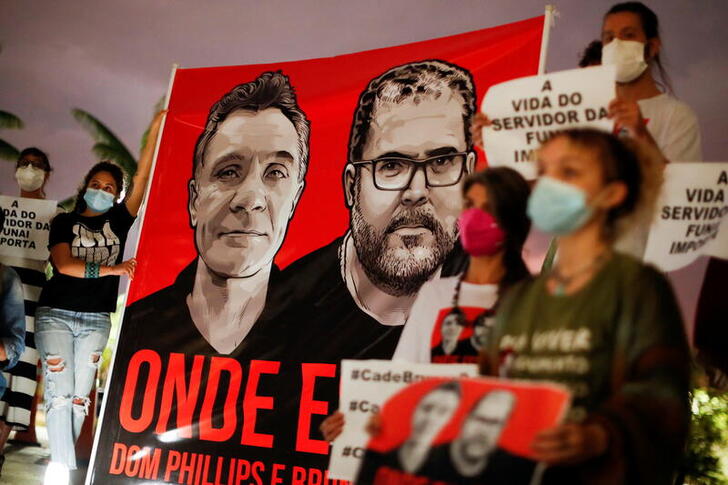
On June 5, Pereira and British journalist Dom Phillips, who was researching a book there with Pereira’s guidance, disappeared along with their boat, a day after Pereira was threatened by an illegal fisherman in the area.
A threat letter accused Pereira of “telling the Indians to arrest our motors and take our fish”. A fisherman is under investigation in association with the pair’s disappearance, police said.
A television channel quoted Phillips’ wife on Monday as saying the two men’s’ bodies had been found, but Brazil’s federal police denied that, saying only that items belonging to the men had been recovered in a river near where they disappeared.
Both were veterans of travel in the remote valley near the Peruvian and Colombian borders, home to the biggest concentration of Brazil’s remaining isolated and uncontacted indigenous tribes.
But under what analysts say is a weakened Funai, indigenous areas in the “wild west” of the Amazon have faced worsening incursions by land grabbers, gold miners, illegal hunters and fishermen and drug trafficking gangs.
‘ANTI-INDIGENOUS’ AGENCY
On Monday, Indigenistas Associados (INA), an institution that represents Funai agents, released a dossier in partnership with the Institute of Socioeconomic Studies, a nonprofit organisation focused on public policies, accusing Bolsonaro’s government of persecuting public employees such as Pereira and transforming Funai into an “anti-indigenous” agency.
The document said Bolsonaro had carried out his threats to weaken Funai and not recognize “one more centimeter” of indigenous land with formal protection.
The changes have put indigenous communities – and those who work to protect them, such as Pereira – at greater risk, said Fernando de Luiz Brito Vianna, president of INA and one of the authors of the dossier.
In response to the charges in the dossier, a Funai spokesperson said that the agency “acts in strict obedience with the principles of legality, impartiality and morality” and that its work is in the public interest.
Charges of persecution of agents within Funai were unfounded, the spokesperson added, noting agency heads had the right to hire and fire directors and other key staff as they wished.
According to the dossier, career Funai officers have been sidelined since Bolsonaro’s election and replaced with people with far less experience of indigenous matters.
Of 39 coordinators currently working in the agency, 17 are military officials, five are police officers and six have no previous experience in public administration, it said.
Pereira was replaced as coordinator in 2019 shortly after dismantling illegal mining operations in the Yanomami indigenous reserve, part of his efforts to protect uncontacted indigenous groups at Funai.
After taking leave from Funai, he went on to support the Union of Indigenous Peoples of the Javari Valley (Univaja), teaching activists to operate drones and map and document crimes to report them to authorities.