

By Thin Lei Win
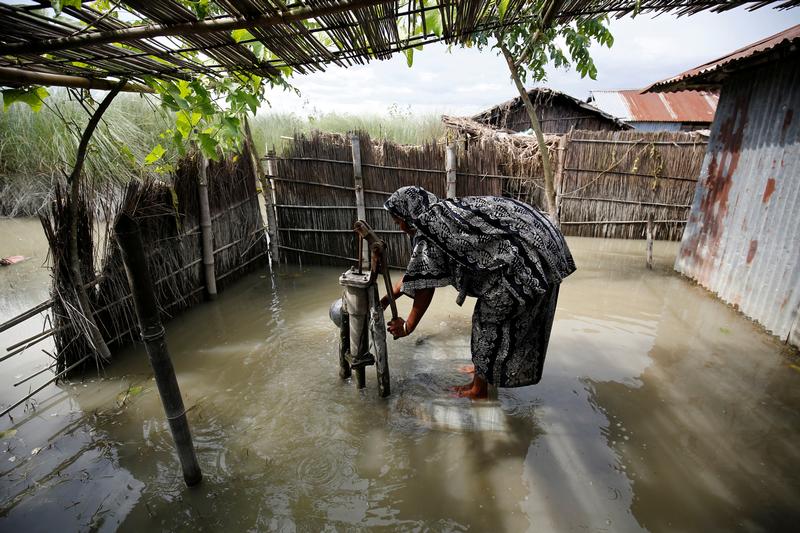
BANGKOK, Aug 28 (Thomson Reuters Foundation) – Almost a quarter of a century after public health experts discovered mass public poisoning in Bangladesh caused by water contaminated with arsenic, the government is planning a new push to end the scourge, while researchers are designing an app to find safe sites for new wells.
About 20 million Bangladeshis, or one in eight, have been drinking water with arsenic levels higher than the government’s limit of 50 microgrammes (μg) per litre, said Kazi Matin Uddin Ahmed, geology department chair at the University of Dhaka.
That limit is five times higher than the World Health Organization (WHO) guideline of 10 microgrammes per litre.
When the lower ceiling is used, the number affected jumps to 45 million people, according to a book published this month by the International Water Association.
Long-term exposure to the highly toxic substance – which is colourless, tasteless and odourless but found in millions of shallow wells across Bangladesh – leads to arsenicosis, which can cause skin lesions, cancer, cardiovascular disease and diabetes, as well as impaired cognitive function in children, according to the WHO.
In 2002, the U.N. agency described the Bangladesh crisis as “the largest mass poisoning of a population in history”.
“It’s been an emergency for the past 20 years,” said Alexander van Geen, a professor at Columbia University’s Lamont-Doherty Earth Observatory, who has worked with Ahmed since 2000 to find solutions.
An estimated 5 percent of deaths in Bangladesh are attributable to drinking water that is high in arsenic, he said.
Now the Bangladesh government is planning a four-year, $200-million programme to tackle the problem, according to officials at the Department of Public Health Engineering (DPHE).
Proposed activities include testing wells, raising awareness of the dangers, and installing site-specific solutions, said Md. Saifur Rahman, an executive engineer with the DPHE.
The plan is awaiting approval by a high-level government committee, and could start next year, officials said.
The sheer number of wells – around 10 million, 90 percent of which are privately owned – makes testing and maintaining them a huge task.
Between 1999 and 2006, donors and the government organised awareness-raising programmes and the testing of nearly 5 million wells, but efforts tapered off after that, according to a 2016 Human Rights Watch (HRW) report.
Paint marking safe and unsafe wells has worn off, while many new ones have been dug and people mistakenly believe the issue has largely been resolved.