

• Former police captain Adams plans to revive public transit, housing
• Adams says will build on the city’s climate goals and narrow racial inequities
By Matthew Lavietes
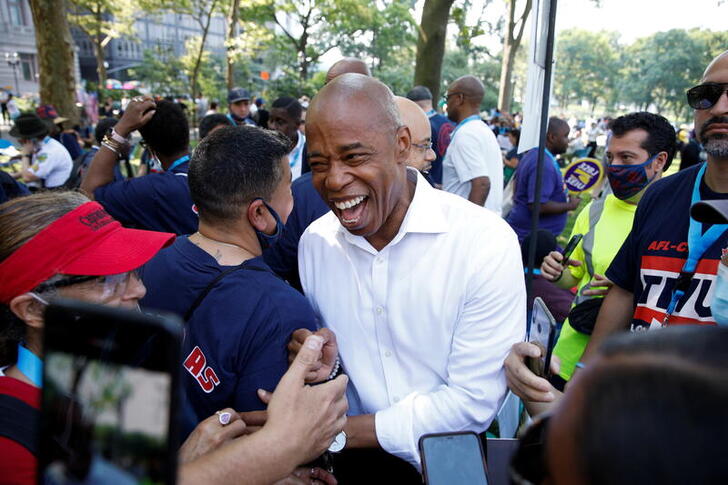
NEW YORK, July 7 (Thomson Reuters Foundation) – Eric Adams, a former police captain and the borough president of Brooklyn, declared victory in the Democratic nomination for mayor of New York City on Tuesday, all but guaranteeing he will head the largest city in the United States.
He has a formidable task on his hands: Adams will have to steer the city out of economic devastation caused by the pandemic which crippled its sprawling public transit system and deepened longstanding inequalities.
The policies enacted by New York’s next mayor could have ramifications that stretch well beyond the Big Apple
Here is how Adams suggests he will tackle some of New York City’s most pressing issues:
Public transit
One of the biggest tasks for the city’s next mayor will be to revive and improve its vast public transit system, New York’s coronavirus-hit Metropolitan Transportation Authority (MTA).
Amid the pandemic, New York’s subway system, considered the lifeblood of the city, saw a sharp decline in ridership.
As of June 18, the city’s subways had roughly 2.57 million riders, or roughly 46% of the 5.5 million riders that the subways averaged pre-pandemic in February 2020, according to data from the state of New York.
“The great challenge facing the mass transit system is having people return to work,” said Mitchell Moss, the Henry Hart Rice Professor of Urban Policy and director of the Rudin Center for Transportation at New York University.
“People are not going to be riding the MTA five days a week anymore. They may come in three or four days a week,” Moss told the Thomson Reuters Foundation, referring to the agency that runs the city’s subways.
Suburban commuters who have become accustomed to working from home or commuting by car will be the most difficult to lure back to using New York’s transit system, Moss said.
To get commuters to ditch their cars, Adams said he would back a state-approved congestion pricing plan.
Similar to those of cities around the world, such as London, the plan would charge fees for people driving into the busiest parts of Manhattan. If passed, New York would become the first American city to impose such a fee.
Adams has also proposed to add 150 miles of bus lanes and busways over four years. The city currently has 138 miles of bus lanes, less than other major cities such as London, which has roughly 180 miles of busways.