

YAOUNDE, Nov 16 (TrustLaw) – There is a huge need for free legal help in Cameroon but only a few major law firms in the country have enough well-paying corporate and individual clients to be able to set aside funds for pro bono services, lawyers say.
A new law requires the government of Cameroon – where 40 percent of population lives below the poverty line – to provide legal aid for those otherwise unable to afford a lawyer. But procedures for obtaining these funds are cumbersome and the payments are very small, which puts many good lawyers off taking on legally aided cases.
And few are prepared to work for free.
“When the firms are not viable and lawyers themselves have survival problems, it is difficult for them to set out to help people for free,” said Innocent Bonu, a prominent lawyer in the west-central African country.
Those that do work pro bono do it on an ad-hoc basis and usually take on cases at the last minute, the Cameroon Bar Association said.
The association sometimes asks lawyers to provide pro bono help in emergencies, for example during riots and strikes when protesters could be arrested and tried in a fast-track process.
Another barrier to pro bono is a fear among lawyers that giving too much legal advice for free may give Cameroonians a wrong impression.
“We are in a country where people do not understand the usefulness of advocates, so if you try to push pro bono too far, people might think that is the rule rather than the exception,” Eta Bessong Junior, the chairman of the Cameroon Bar Association, told Trustlaw.
However, an over-abundance of pro bono services is not, for now, a risk in Cameroon. Most of the free legal help Cameroonians receive is paid for in some way.
For example, some non-governmental organisations (NGOs) encourage lawyers to help poorer Cameroonians by paying them for the expenses of handling a case, such as court fees.
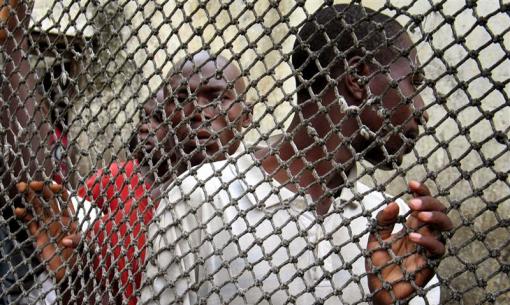
One such project, called PACDET II and funded by the European Union, aims to decongest Cameroon’s biggest prisons by commissioning lawyers to represent detainees awaiting trial. The project pays lawyers 200,000 CFA francs (${esc.dollar}400) per case, regardless of how long the case takes.
“We see this as pro bono work because we know what we give is not proportionate to what a lawyer would get in reality for a case that lasts for two to three years,” said Mirielle Mbiiga Etia, a lawyer for the EU project. “We’ve asked them (lawyers) to consider it as a humanitarian action.”
Government data show that in 2009 almost two-thirds of Cameroon’s 24,000 prisoners were awaiting trial and, according to the Cameroon Bar Association, many of them had been awaiting trial for five to 10 years. Progress on such cases was slowed by their complexity, judicial inefficiency, staff shortages and corruption, a U.S State Department report said.
Although beneficiaries have hailed these quasi-pro bono projects as a success, their sustainability is a constant worry as it depends entirely on whether donors will continue funding such work.
NGO Centre d’Animation des Jeunes pour l’Appui au Developpement (CAJAD), based in the coastal town of Limbe about 380 km (236 miles) from Yaounde, used to pay two lawyers for the expenses of handling human-rights cases, but its funding for this dried up a year ago.
Moreover, lawyers’ lack of dedication to quasi-pro bono work is a problem.
“The willingness, engagement and commitment of lawyers is a problem because if they have a client who can give them money, they would go with them and promise you that they would come tomorrow or the day after, and finally your case that could be handled in two days would take a month or more,” said Bartelemy Tchepnang, the head of CAJAD.
Eta Bessong of the Cameroon Bar Association lamented such attitudes, saying: “The violation of justice for one person is the violation of justice for everybody. The fact that someone has no means to pay should not deprive the person of justice.”