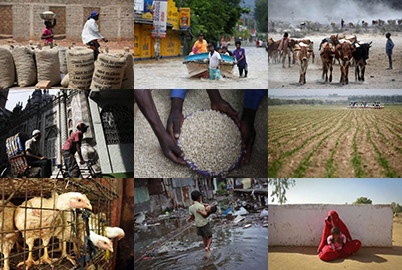
In coping with climate impacts, migration "far from being a problem could be part of the solution", one expert says
LONDON (AlertNet) – Migration linked with climate change is more likely to involve a steady step-up in existing patterns of movement around the world than the sudden surges of desperate refugees many governments fear, climate and migration experts say.
Many argue, in fact, that migration – if prepared for and managed – could prove one of the most effective means of adapting to climate change and building resilience to its impacts, particularly if migrants send remittances home.
“When we think of climate migration, we think of areas emptying, of what happens if 10,000 people leave,” said Dan Smith, the head of International Alert, a London-based peace-building organisation. But much current - and probably future - migration focuses instead on people saying, “We’re a family. I’ll go, you stay. I’ll send some money home so you can survive.”
“It’s a different kind of migration from that odd picture we’ve constructed for ourselves,” Smith told a recent discussion at the Royal Commonwealth Club on the security challenges of climate change and migration.
Already there are 200 million people living in a country other than the one they were born in, and another 750 million people living in their native country but outside their region of birth – a total of about a billion migrants worldwide, said Richard Black, a professor of human geography at Sussex University and contributor to the UK government’s 2011 Foresight project, which explored the potential impact of climate change on migration, among other issues.
Predictions of how much climate change might add to that migrant flow by 2050 range from 200 million people, according to the 2006 Stern review, to a billion, according to a 2007 Christian Aid report.
But there is “a huge dilemma in delivering any kind of number for the future” on climate-linked migration, Black said.
That’s because a variety of pressures – including economic, environmental and social – often contribute to a migrant’s decision to move, making it hard to identify a sole cause.
The potential severity of climate impacts, from sea-level rise to extended droughts and worsening floods, also remains tough to predict accurately as climate-changing emissions continue to rise.
“Changes in the climate do have an impact in the decision to migrate, but it’s not clear how big that is,” said Elizabeth Deheza, who recently carried out a study on the subject in Mexico as part of her work for the climate change and security programme at the UK Royal United Services Institute.
That point is important, she said, because many governments - including Mexico’s - are pushing hard to understand climate migration as a problem separate from “normal” migration, saying “they need to isolate (the problem) to tackle it.”
But seeing climate-related migration in isolation won’t give an accurate view of it, she said. “That was the major problem we had, trying to make them understand they had to see the bigger picture,” she added.
RELUCTANT TO LEAVE
What is clear, she and other experts said, is that climate migrants prefer to remain inside their own countries rather than crossing borders, and that their movement resembles that of other migrants. It usually involves just part of a family moving to look for work, often to places where relatives or friends could provide leads on jobs and other assistance.
Governments and policy makers may expect “a lot of people moving across borders”, she said, but research so far doesn’t bear that out.
In the coastal Sunderbans area in far southern Bangladesh and India, families losing their island farmland to rising seas and saltwater intrusion generally respond first by sending a male member to work elsewhere and send resources home, said Malini Mehra, the founder of the Bangalore-based Centre for Social Markets.
Even when the land is on the verge of disappearing altogether, most families are reluctant to give up their claim to it and will often “leave the youngest person there in case the island doesn’t sink” while the rest move elsewhere, she said.
Sending some family members away to find work could be one of the most effective ways of dealing with climate stresses, the experts predicted, particularly given that migrants around the world already send home $240 billion a year in remittances, according to World Bank figures.
In general, “migration is (often) about minimising risks rather than maximizing income” and can help deal with shocks of all kinds, Black said. Similarly, in coping with climate change impacts, migration “far from being a problem could be part of the solution”, he said.
But persuading governments of that remains a challenge, the experts warned, as migration remains a politically sensitive issue in many countries.
When talking with government officials about migration, “there’s an emotional reaction you get … not logic,” Malini said. “It’s a fear of deluge; of great alien hordes entering your country … It plays into all our irrational emotional fears.”
Changing that will mean convincing officials that migration is “a way of managing your risk” and that “migration doesn’t always have to have negative outcomes,” she said.
Our Standards: The Thomson Reuters Trust Principles.