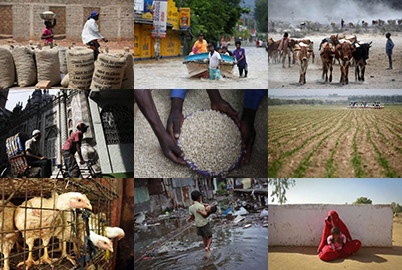
Social protection plays a key role in reducing the impact on the poor of emergencies such as natural disasters and unemployment, but most countries spend little on it and existing programmes discriminate against women and those in informal sectors
BANGKOK (Thomson Reuters Foundation) – Large numbers of poor and vulnerable people in the Asia Pacific region are exposed to risks such as natural disasters and unemployment because countries spend “far too little” on policies and programmes to protect them, a new report by the Asian Development Bank said.
Despite impressive growth in recent decades, the majority of countries in the region, particularly those that have graduated to middle-income status, have not strengthened their social protection systems -- policies and programmes designed to reduce poverty and people’s vulnerability to emergencies -- it said.
The report, which ranked countries’ social protection systems using 2009 government data, urges governments to scale up and broaden the systems by spending 5 percent of Gross Domestic Product (GDP) per capita on them -- as South Korea, which has a Social Protection Index (SPI) of 0.200, has done.
The ranking is based on the availability of social insurance, social assistance such as cash or in-kind transfers, child welfare, assistance to the elderly and disabled, and labour market programmes such as skills development and training.
Currently only four out of 35 countries -- Japan, South Korea, Mongolia, and Uzbekistan -- have SPIs that are at or above 0.200. Japan has the highest SPI, 0.416.
Spending in most middle-income countries, including Armenia, Fiji, India, Indonesia, Pakistan, the Philippines and Samoa, remains below 3 percent of GDP.
Uzbekistan and Mongolia have GDP per capita ($1,187 and $1,692 respectively) that is much lower than Singapore ($35,514), Malaysia ($6,915) and Thailand ($4,151) but took second and third place in the index, reflecting comprehensive programmes that were adopted under communism.
EQUITABLE PROTECTION
The report, which also disaggregated the data by gender, found women in most Asia Pacific countries are at a disadvantage in receiving social protection.
Social insurance, which usually benefits only those who are formally employed in the public sector or large private sector firms, dominates social protection in many countries.
This leaves informal workers, many of whom tend to be women, unprotected.
“Countries in Asia and the Pacific need to expand their social protection systems and make their impact more equitable”, the report said, suggesting they increase social assistance programmes such as cash transfers and child welfare.
“Because gender inequality is often tied to structural conditions, such as the lack of access of women to well-paid, formal employment, policy makers in Asia and the Pacific are most likely to make substantial inroads in reducing such inequality when they begin to universalize social insurance benefits, such as for health care and pensions,” it added.
In addition, while there is a positive relationship between a country’s GDP and its SPI, governments need not wait until their country becomes prosperous to invest in social protection, said Bart W. Édes, director at ADB’s Regional and Sustainable Development Department.
“Well-structured and capably implemented social protections promote the population's well-being in all countries,” he told Thomson Reuters Foundation, pointing to the Kyrgyz Republic and Nepal, which have higher SPIs than other low-income countries.
DISASTER RELIEF “MAJOR PRIORITY”
The report also identified a large “missing middle” – people who are not considered poor but are vulnerable to external shocks such as natural disasters, unemployment and death in the family – who are not benefiting from any social protection systems.
“Improving disaster relief, which has continued to increase in importance, should now be regarded as a major priority,” it said.
Asia Pacific is the most disaster-prone region in the world, and poor and marginalised people in the region are disproportionately affected by disasters.
“Cash transfers and public works programs provide poor people with income that can be used to build their resiliency. Relief provided after a disaster - cash, food, and essential services - can save lives and help survivors get back on their feet,” Édes said.
Different forms of insurance offer some guarantee that assets and savings would not be completely wiped out, he added, pointing to the ADB and Japan’s support of a trial of crop insurance products that would protect the income of smallholder farmers in Bangladesh from increasingly severe storms and natural disasters.
Our Standards: The Thomson Reuters Trust Principles.