* Any views expressed in this opinion piece are those of the author and not of Thomson Reuters Foundation.
Read about how TRF travelled to Mumbai to help financial journalists
“Can I offer you my umbrella, ma’am?” said the man next to me on the pavement when the clouds burst and the Mumbai Monsoon pounded down with unnerving ferocity. It is this kind of friendly courtesy to a stranger standing ankle-deep in a gushing stream outside the Reserve Bank of India that typifies much of what we encountered on our visit.
Mathieu Robbins and I were in Mumbai earlier this month to run a Reporting Economics workshop for the Thomson Reuters Foundation. Organised by the International Monetary Fund and the Reserve Bank of India, the intense two-day course aims to advance local print and broadcast reporters’ knowledge of the most effective way to handle economic and financial news.
We’ve held these TRF courses before and usually we work with young journalists who are not economic experts. More often than not, they are terrified of phrases like fiscal deficit, monetary policy and consumer price index. So, we spend a lot of time demystifying economic terminology and removing the fear of numbers held by so many reporters.
India was different. We faced a group of around 20 men and women who were mostly financially literate and this time our challenge was to help them convert their strong knowledge into easily accessible language and simple news reports that their audience could grasp quickly.
“I have no idea what I am reading in the newspapers. They use these very big words and to understand what is going on in my country I have to read it again and again and again. I don’t have time for that,” a pool attendant told me one evening as I sat on the shady verandah of the Taj Mahal Palace Hotel, sipping a gin & tonic while Mat swam.
So, over two exhausting, challenging and fun-filled days we put the Mumbai media representatives through their paces.
We drilled them in the ethics of journalism, the importance of accuracy over speed, the significance of balance and objectivity in any story, how simple language and short sentences achieve far more than jargon and convoluted language. They loved it. They loved it so much that on both days we stayed well beyond the working hours of the central bank, leaving in the dark around 7pm because the lights had been turned off!
And, we learned too. As always, the egalitarian, flexible style of coaching and facilitation employed by the TRF enables all those participating to learn from each other – trainers and participants alike. Mat and I learned about the complexities of the Indian economy, the extreme wealth gap and the vibrant culture of India’s most populous city, formerly known as Bombay and the site of the award-winning film “Slumdog Millionaire”.
But, above all, we learned that these journalists hold a real passion for their vocation and how could they not? Covering the Indian economy at a time when growth has slowed considerably, the rupee is in free-fall, and the current account deficit is terrifyingly low must be a rewarding challenge. Not to mention the contrasting faces of the country.
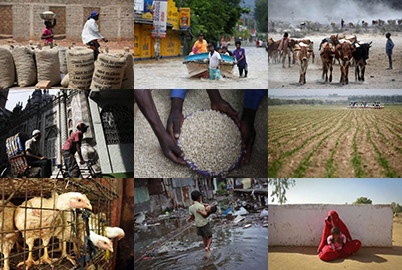
Yes, a few days is insufficient to know any place but Mumbai allows one a glimpse at the truths of India. On the one hand we enjoyed the luxury of the Palace hotel, leafy avenues, impeccable service and heavenly dining. On the other, our eyes were opened to the stench and squalor of the sprawling slums, the beggars and the tight police security.
Looking back at this experience, one quality of the Indian journalists we met is memorable and brings a smile to my face: the deep desire for the dramatic. In a workshop exercise on sourcing where a politician accidentally shoots his friend on a hunting trip – facts confirmed by the politician, his friend, eye witnesses and police – our group of journalists were adamant this was no accidental shooting. Despite numerous sources and clear-cut facts, they questioned motives and background. Not a bad quality in a country where the bureaucracy is so allegedly corrupt.
Our Standards: The Thomson Reuters Trust Principles.