

By Megan Rowling
OLIVELLA, Spain, Feb 26 (Thomson Reuters Foundation) – As flames and smoke from burning bushes billowed towards them, Catalan firefighters calmly controlled the progress of a planned fire on a forested hillside – an exercise aimed at reducing the danger of blazes breaking out later in the summer heat.
Prescribed forest burns like this, which thin out flammable undergrowth, are a well-known way of lowering wildfire risks, which are rising as the Earth’s climate heats up.
Less understood is the impact on the health of the people who work to prevent and battle those forest fires.
On a mild February morning in the countryside south of Barcelona, a low-cost monitoring device was field-tested for the first time. Its aim is to better protect firefighting teams – and in the longer term, populations living near fire-prone areas.
“In the 20 years we have been doing this type of work… we have become more conscious of the fact that we are dealing with toxic elements,” said veteran fireman Joan Herrera, who launched a push to identify the effects of smoke inhalation after suffering headaches and respiratory problems.
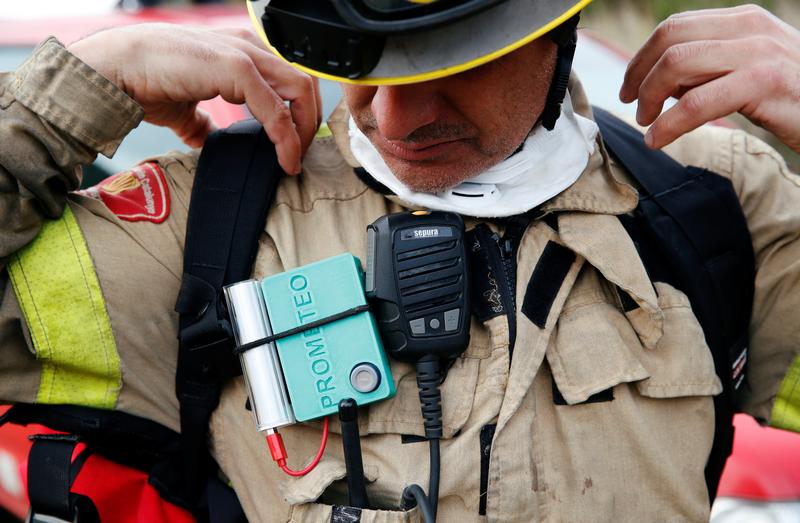
He and an emergency nurse have worked with a volunteer team of three Barcelona-based IT developers and data scientists on the “Prometeo” device and software, which won an annual “Call for Code Global Challenge” led by technology giant IBM in 2019.
IBM is providing computing services and expertise to enable the open-source solution to be deployed around the world in fire-prone places, from Spain to Australia and California.
“We first have to… understand what is happening to us, detect the smoke concentration and how is it affecting the level of carbon monoxide, and through the software… we can decide how the firefighter is doing over time and if we can continue to use him or should take him out to rest,” said Herrera.
Ten of the group of about 30 firefighters conducting the burn near the village of Olivella wore small 3D-printed green boxes on the front of their uniforms, containing sensors that detect levels of carbon monoxide, temperature and humidity.
Using the Internet of Things, cloud-based computing and artificial intelligence, that data was fed and converted into an app monitored on screens in a tent further down the hillside.
For each firefighter, the computer icons changed from green to amber or red when the carbon monoxide around them spiked.
“If I know today that (fighter) number three has been very exposed to (carbon monoxide) all day, tomorrow the computer will be able to say he should not go out,” explained Prometeo team member Josep Ràfols.
Emergency services personnel “will never tell you if they are feeling bad or dizzy… but this is data”, he added.
The plan now is to gather enough data to produce medically significant results, improve the reusable device – which Ràfols said could be produced for less than 10 euros ($11) – and find business partners to deploy it more widely.
Prometeo developer Salomé Valero said if the technology worked well in Catalonia, she hoped it could be rolled out elsewhere, starting in Australia where there are many volunteer firefighters who lack high-tech tools like Prometeo.
“Firefighters are a large international family,” she said. “They all have a mechanism to learn from each other when there is a big fire, as in Australia, Greece, Portugal, here in Spain or in America.”